INDEX
1. Preface
This revised Edition-B clarifies the scientific positioning of SAN-EI AM Solar Simulator Standards 2025-04 in relation to internationally recognized photovoltaic standards.
The objective of this document is:
• To clarify the physical definition of AM0 irradiance
• To ensure methodological alignment with IEC spectral evaluation principles
• To distinguish clearly between IEC-defined classifications and SAN-EI internal extended classifications
• To improve transparency and international comparability
This document is intended as a technical clarification. It does not replace, redefine, or supersede any existing international standard.
2. Acknowledgement
SAN-EI ELECTRIC expresses its sincere gratitude to
Dr. Harald Müllejans
European Commission – Joint Research Centre (JRC)
for his valuable technical comments and guidance.
His observations regarding spectral fidelity and measurement transparency contributed significantly to improving the clarity and positioning of this revision. Responsibility for the final content remains solely with SAN-EI ELECTRIC CO., LTD.
3. Positioning of This Document
International standards such as:
• IEC 60904-3 (AM1.5G reference spectrum)
• IEC 60904-9 (solar simulator performance requirements)
• ASTM G173 (terrestrial reference spectral irradiance)
• ASTM E490 (extraterrestrial reference spectral irradiance)
define reference spectra and evaluation criteria primarily for AM1.5G conditions.
At present, IEC does not define an operational AM0 irradiance constant for simulator calibration. This document adopts ASTM reference data to clarify AM0 definition while maintaining methodological compatibility with IEC evaluation frameworks.
4. Definition of AM0 (1 SUN = 1348 W/m²)
AM0 irradiance is adopted as
1348 W/m² integrated over 280–4000 nm
derived from the latest ASTM E490 extraterrestrial reference spectrum.
Clarification
• IEC standards define AM1.5G, not AM0
• The value 1348 W/m² is derived strictly from ASTM reference integration
• The integration range (280–4000 nm) is selected for methodological consistency with AM1.5G evaluation principles • This document does not establish a new international solar constant
5. Measurement Principle and Detector Considerations
5.1 Detector Sensitivity
Typical AM1.5G reference detectors:
• Silicon-based
• Effective response range: 400–1100 nm
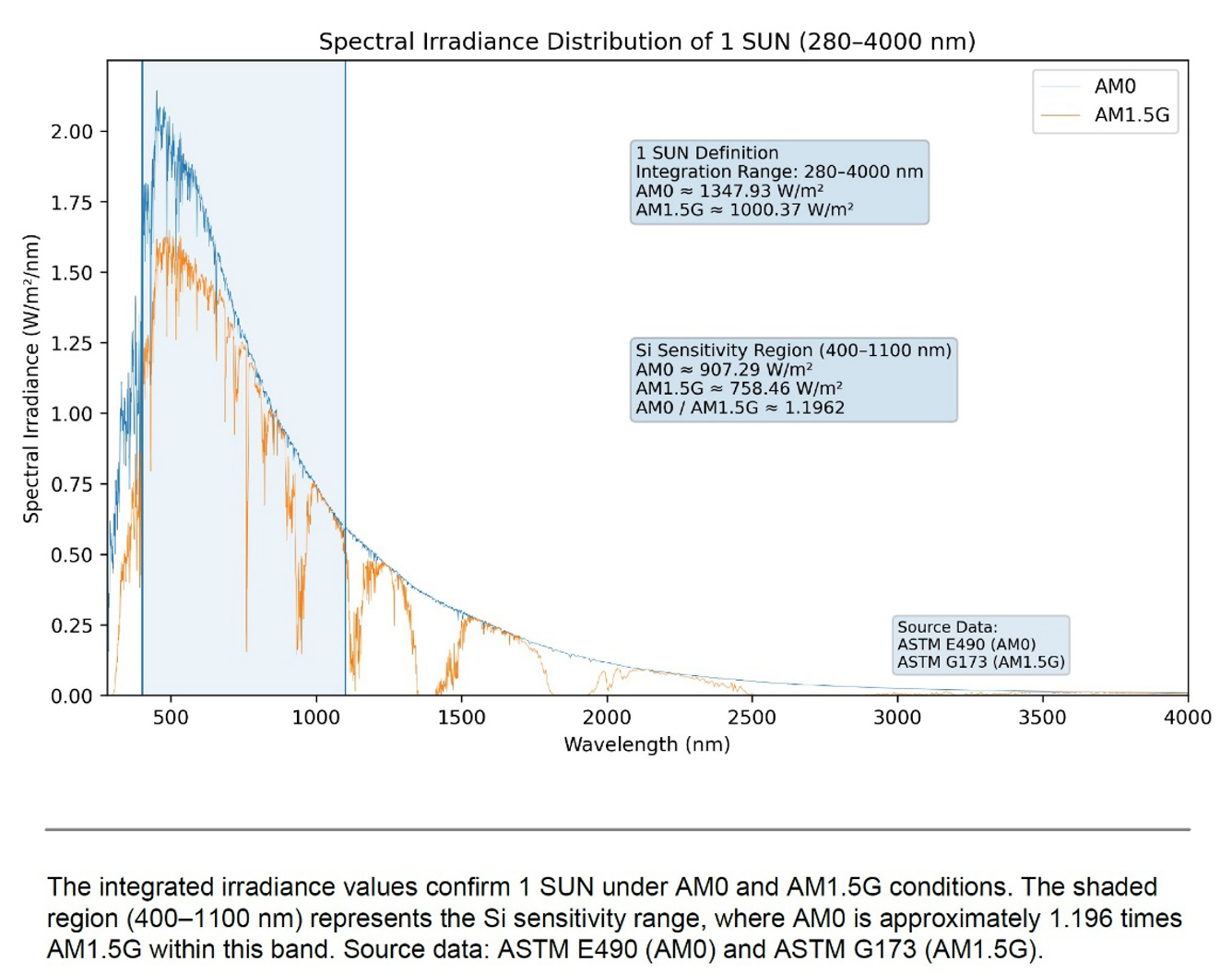
Full integration range (280–4000 nm) exceeds this response window. Therefore calibration relies on spectral integration ratios derived from reference data.
5.2 AM0 / AM1.5G Ratio
From ASTM reference integration:
280–4000 nm
AM1.5G = 1000.37 W/m²
AM0 = 1347.93 W/m²
400–1100 nm
AM1.5G = 759.01 W/m² AM0 = 908.13 W/m
Ratio
908.13 / 759.01 = 1.20
When using an AM1.5G-calibrated Si detector, a signal 1.20× higher corresponds approximately to AM0 1 SUN.
Scientific Note This ratio represents a practical calibration method and does not replace full-spectrum radiometric measurement.
6. Spectral Match Classification
6.1 IEC Classification (Reference)
| IEC 60904-9:2020 | Wavelength range to be evaluated | ||
|---|---|---|---|
| 400-1000nm | 300-1200nm | ||
| Divisions | quantity | 6 | 6 |
| percent | 12.5-19.9 % | 16.7 % | |
| Spectral Match | |||
| Accuracy | Class | ||
| ≦±12.5 % | 87.5-112.5 % | —– | A+ |
| ≦±25 % | 75-125 % | A | —– |
| ≦±40 % | 60-140 % | B | —– |
| ≦±60 % | 40-200 % | C | —– |
6.2 SAN-EI Extended Evaluation Ranges
To support advanced multi-junction and space photovoltaic applications, SAN-EI evaluates:
- 300–1200 nm (IEC-aligned)
- 300–1800 nm
- 300–2200 nm
Clarification
SAN-EI extended classes (A++, S++, SS+, etc.) are internal technical classifications and are not part of IEC standards.
They represent tightened tolerances and expanded wavelength evaluation for research and aerospace applications.
| SAN-EI AM Solar Standards 2025 | Wavelength range to be evaluated | |||
|---|---|---|---|---|
| 300-1200nm | 300-1800nm | 300-2200nm | ||
| Divisions | quantity | 6 | 8 | 10 |
| percent | 16.7 % | 12.5 % | 10 % | |
| Spectral Match | ||||
| Accuracy | Class | |||
| ≦±7.5 % | 92.5-107.5 % |
A
++
|
S
++
|
SS
++
|
| ≦±12.5 % | 87.5-112.5 % |
A
+
|
S
+
|
SS
+
|
| ≦±25 % | 75-125 % | A | S | SS |
| ≦±40 % | 60-140 % | B | ||
| ≦±60 % | 40-200 % | C | ||
7. Irradiance Uniformity and Stability
Evaluation follows IEC 60904-9 methodology.
Measured performance:
Irradiance non-uniformity ≤ ±2 %
Short-term temporal instability ≤ ±0.5 %
Long-term drift ≤ ±2 % Uniformity is evaluated using the IEC multi-point measurement method.
8. Relationship with Chinese GB/T Standards
GB/T 6494-2017 adopts AM0 reference data based on ASTM E490-2000 using approximately 1367 W/m².
This document adopts ASTM E490 updated integration 1348 W/m².
Difference ≈ 1.4 %.
The integration range (280–4000 nm) remains identical.
Spectral shape consistency is preserved and quantitative differences remain within international radiometric uncertainty levels. Therefore this framework remains technically compatible with GB/T standards.
9. Experimental Verification Summary
Measurements performed using
Dual detector configuration (Si + InGaAs)
Spectral range: 300–2200 nm
Ambient temperature: 25 ±1 °C
Results
Spectral deviation ≤ ±5 %
Uniformity ≤ ±2 %
Cross-device reproducibility confirmed Spectral deviation remains within IEC Class A+ tolerance bands.
10. Standardization Perspective
This framework
• does not replace IEC or ASTM standards
• does not redefine solar constants
• serves as a technical clarification document
• supports unified AM1.5G and AM0 calibration philosophy Future discussions regarding extended wavelength evaluation must proceed within relevant international standardization bodies.
11. Ethical and Peaceful Use Statement
SAN-EI solar simulator systems are developed exclusively for peaceful and scientific applications.
All design, manufacturing and export activities comply with
Japan’s Foreign Exchange and Foreign Trade Act (FEFTA)
Relevant international regulations Unauthorized military or weapon-related use is not supported.
12. Conclusion
Edition-B (Revised 2026) clarifies
• the physical basis of AM0 definition
• methodological alignment with IEC principles
• compatibility with ASTM and GB/T standards
• distinction between international standards and SAN-EI internal extensions
This revision enhances transparency, comparability and scientific clarity.