
1. Purpose of Measurement
The purpose of this test is to verify the reproducibility and stability of irradiance when illumination is restarted after the shutter of a solar simulator has been closed.
In practical use, the shutter is frequently closed during operations such as sample replacement or measurement preparation. Therefore, it is important to understand how quickly the irradiance stabilizes after the shutter is reopened, and whether the duration of shutter closure affects the irradiance level.
In this test, the time-dependent irradiance behavior was measured under different shutter-closure durations in order to evaluate whether the length of shutter closure influences the irradiance behavior after illumination is resumed.
2. Overall Evaluation of the Measurement Results
The irradiance behavior after reopening the shutter was compared under two shutter-closure conditions: 1 minute and 1 hour.
The results show that the irradiance rise behavior is almost identical under both conditions. In both cases, the irradiance is already stable immediately after the shutter is opened, and only a slight upward trend is observed over time.
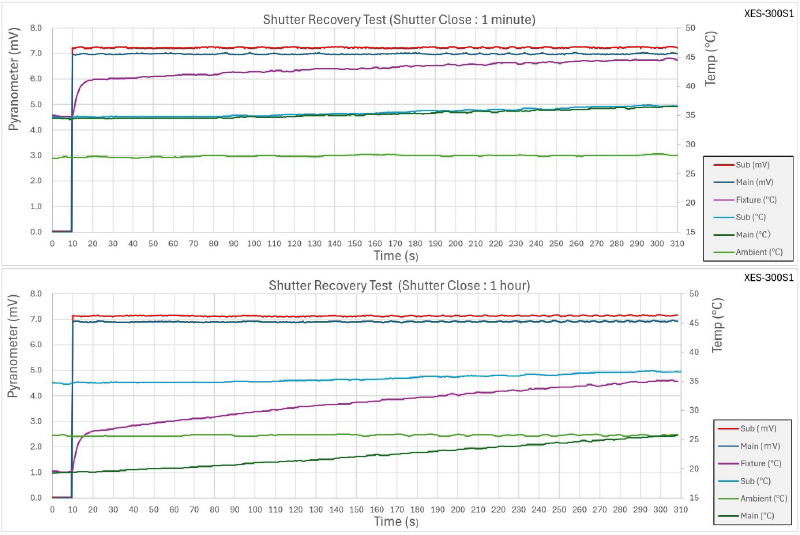
This behavior is considered to be caused by the temperature characteristics of the pyranometer, as previously confirmed in the 24-hour continuous illumination test. Therefore, the observed change does not indicate a change in the irradiance of the light source itself.
No significant differences were observed in the irradiance level or recovery behavior between the two shutter-closure durations.
Based on these results, it can be concluded that the duration of shutter closure does not have a significant effect on the reproducibility or stability of irradiance after the shutter is reopened.
Furthermore, even when the shutter-closure duration was varied from 1 minute to 1 hour, no difference in irradiance behavior was observed. This indicates that changes in the thermal state of the optical system caused by shutter operation have a negligible effect on irradiance reproducibility.
These results also indicate that stable irradiation conditions are reproduced even after routine operational procedures such as sample replacement. From the perspective of operational reproducibility, this behavior represents a favorable characteristic of the solar simulator.
For more detailed discussion of this behavior, please refer to the measurement results of the 24-hour continuous illumination test.
Observations
For the models measured so far, the irradiance observed in the 6H measurements remains within a limited range around the average value, and no significant temporal variation has been observed during the measurement period.
In contrast, the 24H continuous measurements show a gradual change in irradiance together with the increase in pyranometer temperature.
The results obtained from the Main and Sub pyranometers show generally similar trends, indicating that the observed behavior reflects the characteristics of the measurement system rather than a malfunction of an individual sensor.
Note:
Please refer to the individual model pages for detailed measurement conditions and results for each solar simulator model.
| Model | Effective Irradiation Area | Link |
| XES-20S1 | 20 × 20 mm | MeasurShutter Recovery Testement results page |
| XES-40S3 | 40 × 40 mm | MeasurShutter Recovery Testement results page |
| XES-50S2 | 50 × 50 mm | MeasurShutter Recovery Testement results page |
| XES-50S3 | 50 × 50 mm | MeasurShutter Recovery Testement results page |
| XES-70S1 | 70 × 70 mm | MeasurShutter Recovery Testement results page |
| XES-100S1 | 100 × 100 mm | MeasurShutter Recovery Testement results page |
| XES-160S1 | 160 × 160 mm | MeasurShutter Recovery Testement results page |
| XES-200S1 | 200 × 200 mm | MeasurShutter Recovery Testement results page |
| XES-250S1 | 250 × 250 mm | MeasurShutter Recovery Testement results page |
| XES-300S1 | 300 × 300 mm | MeasurShutter Recovery Testement results page |
| XES-300S2 | 300 × 300 mm | MeasurShutter Recovery Testement results page |
| XES-300S3 | 300 × 300 mm | MeasurShutter Recovery Testement results page |
| XES-400S1 | 400 × 400 mm | MeasurShutter Recovery Testement results page |