
1. Purpose of Measurement
This measurement evaluates the temporal stability of irradiance during 24-hour continuous illumination and examines the influence of the measurement system, including pyranometers and the temperature environment.
The objective is to quantify long-term irradiance variation and confirm temperature behavior and consistency between multiple pyranometers.
In some environments, sensor temperature may be controlled at approximately 25°C using devices such as Peltier elements. However, many real-world environments operate without active temperature control.
This measurement assumes typical operating conditions without special temperature control and evaluates irradiance behavior under naturally varying thermal conditions.
Measurement conditions are based on environments commonly encountered in research and manufacturing settings.
2. Definition of 1 SUN
In this measurement, 1 SUN is defined based on the sensitivity constant of a calibrated pyranometer.
1 SUN is determined by:
This series evaluates irradiance stability during continuous illumination.
- The sensitivity constant stated in the calibration certificate (µV/W/m²) corresponding to AM1.5G
- The pyranometer output voltage
Accordingly:
1 SUN is defined as the output voltage corresponding to 1000 W/m² based on the calibrated sensitivity constant.
This measurement is conducted under AM1.5G conditions only.
3. Measurement Items
3.1 Irradiance
- Pyranometer (Main)
- Pyranometer (Main)
3.2 Temperature
- Side temperature of pyranometer (Main)
- Side temperature of pyranometer (Sub)
- Temperature of fixture at non-illuminated portion of irradiation plane
- Ambient temperature near irradiation plane
4. Equipment Used
| Equipment Name | Manufacturer | Model | S/N | Remarks |
| Pyranometer (Main) | EKO | ML-020VM | 04 | Sensitivity Constant: 6.96μV/W/m² |
| Pyranometer (Sub) | EKO | ML-020VM | 03 | Sensitivity Constant: 7.05μV/W/m² |
| Multi-input data logger | KEYENCE | NR-500 | D3900120 7Y520074 | (Main) (Sub) |
| Temperature and measurement unit | KEYENCE | NR-TH08 | 12110317 18010182 | (Main) (Sub) |
| K-type thermocouples |
5. Measurement Positions
- Main pyranometer positioned at the center of the irradiation plane
- Sub pyranometer placed adjacent to the main sensor
- Effective irradiation area: 50 × 50 mm
- For smaller irradiation areas, only the main pyranometer is used
Thermocouples are positioned:
- On the irradiation plane fixture (non-illuminated area)
- In nearby ambient space without physical contact
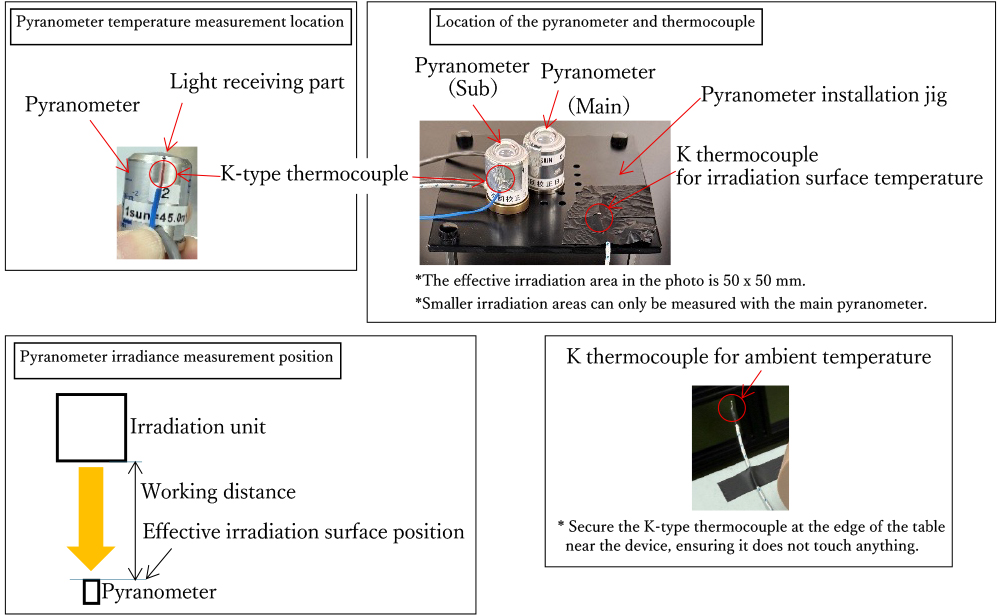
6. Measurement Procedure
- Turn on the lamp.
- Perform a 30-minute warm-up.
- Open shutter and adjust lamp current to reach 1 SUN.
- Close shutter and wait 5 minutes.
- Open shutter and confirm 1 SUN. Readjust if necessary.
- Close shutter and wait 5 minutes.
- Start logging (10-second interval).
- Open shutter and perform 24-hour continuous measurement.
- Close shutter after 24 hours and stop logging.
- Analyze and evaluate data.
7. Data Handling
- Pyranometer output voltage is treated as primary raw data.
- Voltage is converted to irradiance (W/m²) using the calibrated sensitivity constant.
- Evaluation is conducted using both voltage and converted irradiance values.
This ensures transparency and traceability.
8. Data Analysis Items
8.1 Long-Term Variation
- Maximum
- Minimum
- Average
- Variation range (Max − Min)
- Temporal variation rate (Range / Average)
8.2 Sensor Consistency
- Trend comparison (Main vs Sub)
- Correlation tendency
8.3 Temperature Influence
- Correlation between irradiance and sensor temperature
- Correlation between irradiance and ambient temperature
- Presence of temperature-associated voltage change
9. Stability Evaluation Criteria
Stability is evaluated based on:
- Long-term variation remaining within or close to measurement uncertainty.
- Consistent trends between main and sub sensors.
- Temperature is not identified as the primary cause of irradiance variation.
Evaluation is made through comprehensive consideration of these factors.
10. Measurement Uncertainty
Uncertainty includes contributions from:
- Calibration uncertainty
- Sensitivity constant uncertainty
- Data logger accuracy
- Temperature dependence
- Installation and geometric conditions
Overall irradiance measurement uncertainty is approximately ±1% as a practical reference.
Long-term variation evaluation is conducted in consideration of this uncertainty.
11. Validity of the Measurement Method
This measurement examines:
- Reproducibility
- Temperature influence
- Shutter influence on lamp behavior
- Independent cross-check using two pyranometers
The evaluation therefore includes assessment of the measurement methodology itself.